
September is the month when a lot of outdoor safety problems finally get looked at. The summer traffic is over, the weather is turning, and anything that has spent five months in direct sunlight starts to show it. We have had a run of questions recently about ultraviolet exposure and tape, including one from a reader whose personal watercraft had a foam step pad that had gone soft, tacky and unpleasant after seasons in the sun, and who wanted to know whether a marine tape could cover it and restore a safe step.
It is a good question, and the answer applies far beyond boats. Loading bay steps, external staircases, walkways, pontoons, plant access ladders and decking all sit in the same category: surfaces where sunlight, not footfall, is often what kills the material first.
Why UV exposure matters before anything else
Under the Workplace (Health, Safety and Welfare) Regulations 1992, floors and traffic routes must be suitable and kept free from anything that may cause a person to slip or fall. The HSE has been consistent that slips and trips remain the single largest cause of reported major injuries in British workplaces, and a fall on an external stair is a RIDDOR matter as readily as one in a warehouse aisle.
What makes UV degradation a particular nuisance is that it is gradual and easy to miss. A step covering does not fail on a specific date. It loses a little flexibility each month, the colour dulls, the surface chalks, and then one wet October morning it lifts at the edge or the traction is simply not there any more. Nobody logged a defect because nothing looked dramatically wrong.
Specifying for UV stability from the outset is cheaper than reacting. A roll of quality anti-slip tape is a modest cost against the price of replacing a fabricated step assembly, and vastly cheaper than an injury investigation.
What sunlight actually does to a tape
The carrier film
UV radiation breaks the polymer chains in plastics. Unstabilised PVC and polyester films become brittle, shrink slightly and crack. Cheap tapes with no UV inhibitors in the formulation can start crazing within a single British summer, and coastal or south-facing sites see it faster because reflected light off water, glass or pale concrete effectively doubles the dose.
The adhesive
This is where most failures actually begin. Solvent-based acrylic adhesives generally hold up well under UV and heat. Weaker rubber-based adhesives soften, migrate to the edges and pick up dirt, which is why you often see a grey halo around a tired tape before it lifts. Anything applied outdoors should be using an acrylic adhesive as a minimum.
The surface
Aluminium oxide grit itself is inert and does not care about sunlight. What matters is the resin bonding it to the film. Poorly bonded grit sheds, and the slip resistance goes with it. Non-abrasive embossed films rely on their surface pattern instead, so UV-driven softening or hardening of the film changes their grip characteristics directly.
Marine Anti-Slip Tape – H3460Request a sample
Marine tape, salt and sunlight together
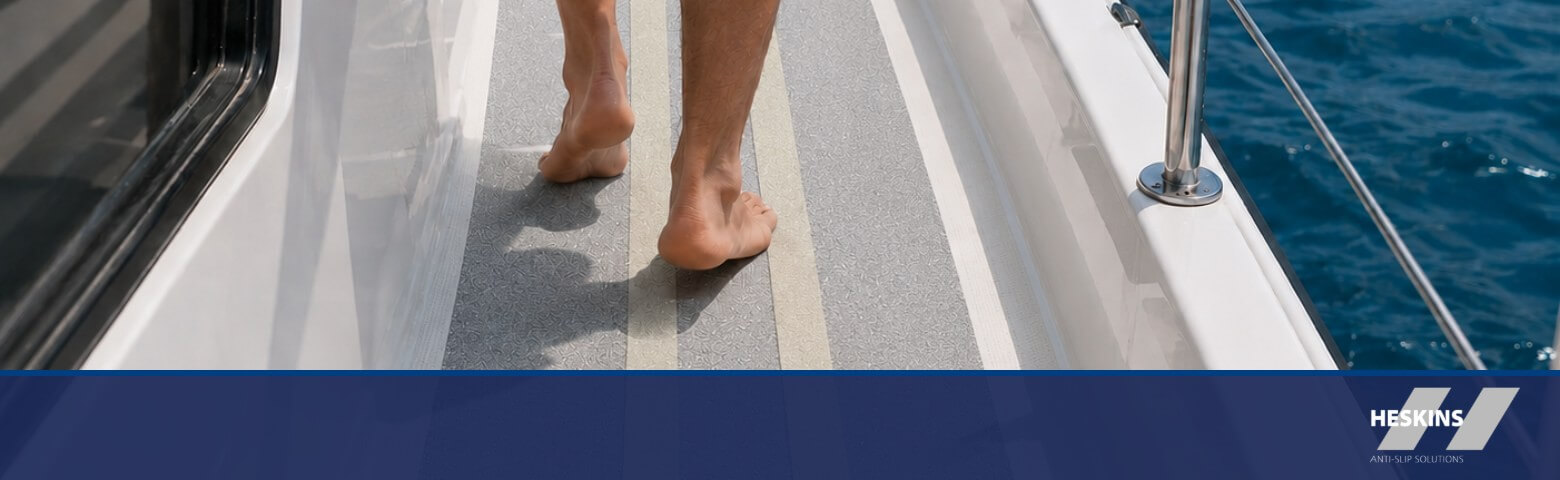
Marine environments are the hardest test a non slip material faces in the UK. You have UV, salt spray, constant wetting and drying, temperature swings and often bare feet. A salt-resistant marine anti slip tape has to combine a UV-stable film, a marine-grade acrylic adhesive that will not creep when warm, and a surface that stays safe when wet.
For the reader with the degrading foam step pad, the practical route is a non-abrasive product. HoldGrip non-abrasive anti-slip tape uses a modified emboss pattern rather than grit, so it gives real hold underfoot without shredding swimwear, wetsuits or bare skin. Applied over a sound, cleaned and dried substrate it also acts as a physical barrier, sealing the degraded foam so it stops transferring to clothing. The same non-abrasive film is sold as TankGrip and Gravel Guard protection tape for motorcycle tanks and fairings, which tells you how it performs as a surface protector as well as a grip aid.
One honest caveat: if the foam has already gone soft and gummy all the way through, tape will cover the mess and give a usable step, but it is a repair over a failing substrate. Bond strength is only ever as good as what it is stuck to. Where the underlying material is crumbling, replace it and then protect the new surface.
Anti slip for steps, decking and walkways
The same thinking applies to every external tread on a British site. Anti slip decking boards, timber pontoons, GRP walkways and painted steel stairs all lose their factory finish under UV, and the resulting smooth, weathered surface is precisely where people go over.
- Steel and concrete steps in heavy boots: a gritted product is the right choice. MagmaGrip aluminium oxide anti-slip tape is a thick, high-traction tape certified for wet as well as dry performance, which suits external stairs used year-round.
- Barefoot or soft-clothing areas: use a non-abrasive film. Abrasive grit and bare skin do not mix, and no slip step tread covers in leisure settings need to be comfortable as well as safe.
- Timber decking: clean off algae first. Green growth under a tape will keep growing and undermine the bond.
- Nosings: BS 8300-2 expects visually contrasting step nosings. A yellow or black and yellow tread on the leading 50 to 55 mm of each tread does the job and satisfies a common access audit finding.
Testing, standards and what to ask for
When you are comparing products, do not accept “UV resistant” as a claim on its own. Ask what it has been tested to. Accelerated weathering to BS EN ISO 4892 gives a meaningful indication of how a film and its pigments will hold up. For slip performance, look for pendulum test data to BS EN 13036-4, which is the method the HSE recognises for assessing slip potential in the UK, and check whether the figures quoted are wet or dry.
Also ask about service temperature range and minimum application temperature. Fitting non slip tape for steps in October at 4 degrees on a damp surface is a common reason for edge lift the following spring, and no amount of UV stability rescues a bond that never formed properly.
A simple autumn check
Before the wet season sets in, walk your external routes and look for chalky or faded surfaces, lifted or curling edges, grit loss, and any foam, rubber or painted finish that has gone tacky. Record what you find, prioritise anything on a stair or a change of level, and specify replacements with UV performance in mind rather than buying whatever is cheapest per metre.
If you are unsure which product suits a particular substrate, send us the details and a photograph. We would rather help you get the specification right first time than have you find out next August that the tape did not survive the summer.